James Tompkin
Associate Professor
Visual Computing
 BlueSky @brownvc.bsky.social
 Github @brownvc
Brown student researcher?
Group Onboarding Process
Contact
BlueSky @jamestompkin.bsky.socialGoogle Scholar
Office hours: Weds 1300 EST
Book appointment
Brown folks: Save an email,
use GCal 'Find a Time'
and include an agenda.
Instructions
Center for Information Technology
Room 547
115 Waterman Street
Providence, RI, 02912

Acknowledgements
My intrepid collaborators and co-authors.
Funding:
- US NSF, DARPA, NASA
- UK EPSRC, BBC
- Industry Activision, Adobe, Amazon, Cognex, Google, Intel, Meta, Snap, AI Foundation
The open source Web community: HTML5 Boilerplate, Ryan Johnston, Joshua N. Hibbert, PracticalTypography.com, EB Garamond.
Hosted on GitHub Pages using Jekyll — basic theme by orderedlist.
James TompkinAssociate ProfessorVisual Computing BlueSky @brownvc.bsky.social Github @brownvc
Brown student researcher? |
Contact BlueSky @jamestompkin.bsky.socialGoogle Scholar
Office hours: Weds 1300 EST
Brown folks: Save an email,
Center for Information Technology
|
Acknowledgements
My intrepid collaborators and co-authors.
Funding:
- US NSF, DARPA, NASA
- UK EPSRC, BBC
- Industry Activision, Adobe, Amazon, Cognex, Google, Intel, Meta, Snap, AI Foundation
The open source Web community: HTML5 Boilerplate, Ryan Johnston, Joshua N. Hibbert, PracticalTypography.com, EB Garamond.
Hosted on GitHub Pages using Jekyll — basic theme by orderedlist.
Light Fields — from Display to 4D Algorithms
The light field is a 4D record of a scene's rays — how do we present it to humans, interact with it, and process it computationally?
A light field captures the radiance at every point in space, in every direction — a 4D function that fully describes how light fills a scene. Captured light fields enable refocusing, depth recovery, and parallax view synthesis; displayed light fields offer glasses-free 3D. The challenge is data density: 4D content stresses capture devices, display hardware, and processing pipelines.
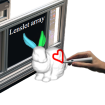
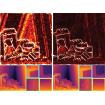
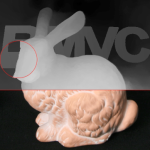
Two sub-arcs sit in this thread. The first (2012–2015) targets light field displays — an Emerging Technologies demo of painting directly into a glasses-free 3D display, content-adaptive lenticular prints that reshape the lenslet array to the captured light field, and a UIST paper that turns that lenslet array into a joint display-and-pen-input surface. The second (2019–2021), led by Numair Khan with Min H. Kim at KAIST, develops dense algorithms over captured 4D content: view-consistent superpixels via epipolar-plane image segmentation, edge-aware bidirectional diffusion for depth, and a differentiable diffusion routine for sparse-to-dense depth from multi-view images.
Authors
Marc Alexa · Simon Heinzle · Stanislav Jakuschevskij · Lucas Kasser · Jan Kautz · Numair Khan · Min H. Kim · Wojciech Matusik · James McCann · Jim McCann · Samuel Muff · Hanspeter Pfister · Henry Stone · Qian Zhang
Papers in this thread